---
title: "bignews.day"
url: "https://bignews.day"
featureImage: "/projects/bignews.jpg"
short: "bignews"
category: "fullstack"
ai: "AI-assisted since Oct 2026"
order: "02"
year: "2024 – now"
tags: ["python", "c", "sqlite", "sqlalchemy", "jinja2", "selenium", "ollama", "whisper", "scikit-learn", "systemd", "tailscale", "raspberry pi", "restic", "ntfy", "cloudflare workers", "netlify"]
---
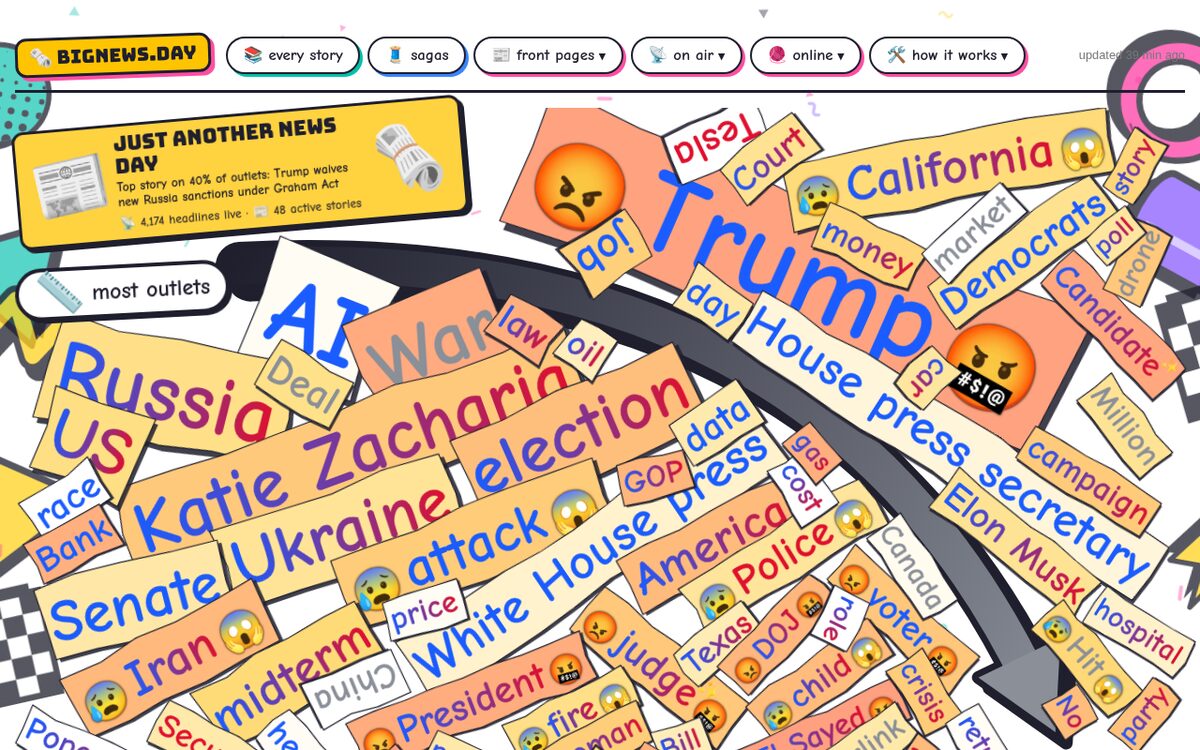
bignews.day watches how the news gets told. It reads the front pages of 145
outlets around the clock and follows each story outward: through wire copy,
TV chyrons, radio newscasts and podcasts (transcribed on my own machine), the
claims people make about it on social media, and what fact-checkers examine.
Headlines are clustered into stories, and stories into multi-part sagas that
run for days or weeks.

The newest layer is a motif index: a catalog of the recurring shapes political
stories take (the owned politician, the senile leader, the carpetbagger...),
built bottom-up from real claims and read against folklore scholarship like
Thompson's motif index. Local models propose where a claim belongs, and a
confidence model trained on my own decisions scores their proposals.

Nearly every model runs locally on a single 10 GB GPU, including a translation
model I fine-tuned for Chinese. The exceptions are the languages no local model
has matched DeepSeek on yet, and drafting the weekly Sunday edition; those go
to DeepSeek over an API for well under a dollar a week. Each model
is chosen by testing the candidates against my own judgments rather than public
benchmarks.
A [methods log](https://bignews.day/methods.html) dates every change to how
things are measured, so a chart that crosses one can be read with it in mind.

## How it runs

The stack is deliberately plain: Python, SQLite through SQLAlchemy, Jinja2
templates, pandas and matplotlib. Every hour a systemd unit on my desktop reads
the front pages (in headless Chromium where an outlet needs a real browser),
sorts the headlines into stories, and renders the whole site as static pages,
which deploy to Netlify behind Cloudflare. A separate worker does everything
that doesn't have to be fresh within the hour. Between runs, a sentinel reads
the top of each outlet's front page, so a big break goes up as a FLASH without
waiting for the next run. Bluesky posts and browser push alerts go out from the
hourly run; the push subscriptions live in a Cloudflare Worker with a D1
database, so the site itself stays static.

It's a record of the news, so a missed hour is a hole that can't be filled in
later. That's why the desktop isn't the only machine that can read the news.
Three backup machines stand in line behind it, all on a Tailscale network and
named for figures from the Völsung saga: otr, an old server at home, and two
Raspberry Pis, regin and fafnir, in two other buildings. Each hour they ask
Tailscale whether the main machine is up. If it's offline, or the site hasn't
published in over two hours, the first one in line that's online reads the
hour itself, and the main machine imports what it caught once it's back. If
something goes badly wrong, one switch in Cloudflare puts the site behind a
"please stand by" screen, an old TV station's off-air card that answers 503
and sends visitors back to the page they wanted once the site returns.

The data is kept the same way. Nightly restic snapshots, encrypted and
deduplicated, go to otr and regin, and regin mirrors its copy on to fafnir.
Alerts reach me through ntfy. Every five minutes the backup machines check on
the main one, and once it has been gone ten minutes, the first of them that's
still online pushes a notification to my phone, then another when it's back.
The same channel tells me when an outlet puts up a security check that needs a
person to pass it.

## History

This is the third version. The first, [Maudlin](/projects/maudlin) (2021), was
a Flask app built on scrapy. The second, Maudlin News (2024), I built by hand:
my own multithreaded spider framework over 114 scrapers, sentiment analysis
with VADER and AFINN, and a story clustering algorithm of my own design. After
trying HDBSCAN and k-means, I settled on TF-IDF cosine similarity, thresholded
into a graph whose connected components are stories, and moved the graph
search into a C extension for a 10x speedup. It generated a static site that
I deployed to Netlify.

In October 2026 I restarted it as bignews.day, building with Claude. That's
how it grew this far, this fast.
<sky-template path="main.html" />

<sky-block name="title">${frontmatter.title} · </sky-block>

<sky-block name="content">
  <article class="project">
    <a class="back" href="/projects">← all projects</a>
    <p class="pills"><span class="pill">${frontmatter.category}</span><span class="pill pill-ai">${frontmatter.ai}</span><span class="year">${frontmatter.year}</span></p>
    <h1>${frontmatter.title}</h1>
    <a class="visit" href="${frontmatter.url}">${frontmatter.url}</a>
    <img class="feature" src="${frontmatter.featureImage}" alt="" />
    <div class="markdown">
      <sky-slot name="content" />
    </div>
  </article>
</sky-block>
<!DOCTYPE html>
<html lang="en">
  <head>
    <meta charset="UTF-8" />
    <script><sky-include path="theme.js" /></script>
    <meta name="viewport" content="width=device-width, initial-scale=1.0" />
    <title><sky-slot name="title" />${meta.title}</title>
    <meta name="description" content="${meta.description}" />
    <meta name="theme-color" content="#142420" />
    <link rel="icon" href="/favicon.svg" type="image/svg+xml" />
    <link rel="stylesheet" href="/style.css" />
  </head>
  <body>
    <!-- Every page is a sheet of paper lying on the source it was built
         from. This checkbox lifts the sheet; no JavaScript involved. -->
    <input type="checkbox" id="xray" class="xray" aria-label="Show the source of this page" />
    <div class="desk">
      <div class="sheet">
        <!-- Under the paper, the page's source, for the candle to show. -->
        <div class="underside" aria-hidden="true"><sky-sources item="underside.html" /></div>
        <div class="paper" aria-hidden="true"></div>
        <svg class="flame" viewBox="0 0 24 44" aria-hidden="true">
          <defs>
            <radialGradient id="flame-body" cx="50%" cy="78%" r="62%">
              <stop offset="0" stop-color="#fffbe8" />
              <stop offset="0.35" stop-color="#ffe08a" />
              <stop offset="0.7" stop-color="#ff9a2e" />
              <stop offset="1" stop-color="#e2470f" stop-opacity="0" />
            </radialGradient>
            <radialGradient id="flame-core" cx="50%" cy="80%" r="55%">
              <stop offset="0" stop-color="#ffffff" />
              <stop offset="0.6" stop-color="#fff3c4" />
              <stop offset="1" stop-color="#ffd166" stop-opacity="0" />
            </radialGradient>
          </defs>
          <path class="flame-body" fill="url(#flame-body)" d="M12 1C15 11 22 18 21 29 20 37 16 43 12 43 8 43 4 37 3 29 2 18 9 11 12 1Z" />
          <path class="flame-core" fill="url(#flame-core)" d="M12 15C14 21 17 26 16.5 32 16 37 14 40 12 40 10 40 8 37 7.5 32 7 26 10 21 12 15Z" />
          <ellipse class="flame-base" cx="12" cy="40" rx="3.2" ry="2" fill="#5aa9ff" opacity="0.45" />
        </svg>
        <label for="xray" class="curl" title="Lift the page to see what it's made of" aria-hidden="true"></label>
        <label for="xray" class="sheet-cover" title="Back to the page"></label>
        <sky-include path="_nav.html" />
        <main class="page">
          <sky-slot name="content" />
        </main>
        <sky-include path="_footer.html" />
      </div>
      <aside class="ground" aria-label="The source of this page">
        <header class="ground-head">
          <p>
            <a href="https://github.com/mas-4/skyblue">skyblue</a> built this
            page from these files, in the order it used them.
          </p>
          <label for="xray" class="ground-close">back to the page →</label>
        </header>
        <sky-sources item="source.html" />
      </aside>
    </div>
    <script><sky-include path="candle.js" /></script>
  </body>
</html>
// The light switch. Until it's flipped, the page follows the system's
// light or dark preference (that part is CSS). Flipping it picks the other
// one and remembers it. This runs in <head>, so a saved choice applies
// before the page is drawn.
(() => {
  const root = document.documentElement;
  const system = matchMedia("(prefers-color-scheme: dark)");
  try {
    const saved = localStorage.getItem("theme");
    if (saved === "light" || saved === "dark") root.dataset.theme = saved;
  } catch {}

  const isDark = () => (root.dataset.theme ? root.dataset.theme === "dark" : system.matches);

  document.addEventListener("DOMContentLoaded", () => {
    const button = document.querySelector(".theme-toggle");
    if (!button) return;
    const show = () => button.setAttribute("aria-checked", String(isDark()));
    button.hidden = false;
    show();
    system.addEventListener("change", show);
    button.addEventListener("click", () => {
      root.dataset.theme = isDark() ? "light" : "dark";
      try {
        localStorage.setItem("theme", root.dataset.theme);
      } catch {}
      show();
    });
  });
})();
<header class="site-header">
  <nav class="nav">
    <a class="brand" href="/">
      <svg class="brand-mark" viewBox="0 0 1536 1174" aria-hidden="true"><use href="/ibis.svg#ibis" /></svg>
      ${meta.title}
    </a>
    <div class="nav-links">
      <a href="/">home</a>
      <a href="/about">about</a>
      <a href="/projects">projects</a>
      <a href="/orbits">orbits</a>
      <label for="xray" class="source-toggle" title="Lift the page to see what it's made of">source</label>
    </div>
    <button type="button" class="theme-toggle" role="switch" aria-checked="false" aria-label="Dark mode" title="Light or dark" hidden><span class="knob"></span></button>
  </nav>
</header>
<footer class="site-footer">
  <div class="social">
  <a href="https://github.com/mas-4">
    <svg
      aria-labelledby="svg-inline--fa-title-Yppzrr98YU17"
      role="img"
      xmlns="http://www.w3.org/2000/svg"
      viewBox="0 0 496 512"
    >
      <title id="svg-inline--fa-title-Yppzrr98YU17">GitHub</title>
      <path
        fill="currentColor"
        d="M165.9 397.4c0 2-2.3 3.6-5.2 3.6-3.3.3-5.6-1.3-5.6-3.6 0-2 2.3-3.6 5.2-3.6 3-.3 5.6 1.3 5.6 3.6zm-31.1-4.5c-.7 2 1.3 4.3 4.3 4.9 2.6 1 5.6 0 6.2-2s-1.3-4.3-4.3-5.2c-2.6-.7-5.5.3-6.2 2.3zm44.2-1.7c-2.9.7-4.9 2.6-4.6 4.9.3 2 2.9 3.3 5.9 2.6 2.9-.7 4.9-2.6 4.6-4.6-.3-1.9-3-3.2-5.9-2.9zM244.8 8C106.1 8 0 113.3 0 252c0 110.9 69.8 205.8 169.5 239.2 12.8 2.3 17.3-5.6 17.3-12.1 0-6.2-.3-40.4-.3-61.4 0 0-70 15-84.7-29.8 0 0-11.4-29.1-27.8-36.6 0 0-22.9-15.7 1.6-15.4 0 0 24.9 2 38.6 25.8 21.9 38.6 58.6 27.5 72.9 20.9 2.3-16 8.8-27.1 16-33.7-55.9-6.2-112.3-14.3-112.3-110.5 0-27.5 7.6-41.3 23.6-58.9-2.6-6.5-11.1-33.3 2.6-67.9 20.9-6.5 69 27 69 27 20-5.6 41.5-8.5 62.8-8.5s42.8 2.9 62.8 8.5c0 0 48.1-33.6 69-27 13.7 34.7 5.2 61.4 2.6 67.9 16 17.7 25.8 31.5 25.8 58.9 0 96.5-58.9 104.2-114.8 110.5 9.2 7.9 17 22.9 17 46.4 0 33.7-.3 75.4-.3 83.6 0 6.5 4.6 14.4 17.3 12.1C428.2 457.8 496 362.9 496 252 496 113.3 383.5 8 244.8 8zM97.2 352.9c-1.3 1-1 3.3.7 5.2 1.6 1.6 3.9 2.3 5.2 1 1.3-1 1-3.3-.7-5.2-1.6-1.6-3.9-2.3-5.2-1zm-10.8-8.1c-.7 1.3.3 2.9 2.3 3.9 1.6 1 3.6.7 4.3-.7.7-1.3-.3-2.9-2.3-3.9-2-.6-3.6-.3-4.3.7zm32.4 35.6c-1.6 1.3-1 4.3 1.3 6.2 2.3 2.3 5.2 2.6 6.5 1 1.3-1.3.7-4.3-1.3-6.2-2.2-2.3-5.2-2.6-6.5-1zm-11.4-14.7c-1.6 1-1.6 3.6 0 5.9 1.6 2.3 4.3 3.3 5.6 2.3 1.6-1.3 1.6-3.9 0-6.2-1.4-2.3-4-3.3-5.6-2z"
      ></path>
    </svg>
  </a>
  <a href="https://stackoverflow.com/users/9691276/mas">
    <svg
      aria-labelledby="svg-inline--fa-title-kGxnyVLHc64Z"
      role="img"
      xmlns="http://www.w3.org/2000/svg"
      viewBox="0 0 384 512"
    >
      <title id="svg-inline--fa-title-kGxnyVLHc64Z">StackOverflow</title>
      <path
        fill="currentColor"
        d="M290.7 311L95 269.7 86.8 309l195.7 41zm51-87L188.2 95.7l-25.5 30.8 153.5 128.3zm-31.2 39.7L129.2 179l-16.7 36.5L293.7 300zM262 32l-32 24 119.3 160.3 32-24zm20.5 328h-200v39.7h200zm39.7 80H42.7V320h-40v160h359.5V320h-40z"
      ></path>
    </svg>
  </a>
  <a href="https://www.linkedin.com/in/michael-sendker">
    <svg
      aria-labelledby="svg-inline--fa-title-BaV39z6dqIIX"
      role="img"
      xmlns="http://www.w3.org/2000/svg"
      viewBox="0 0 448 512"
    >
      <title id="svg-inline--fa-title-BaV39z6dqIIX">LinkedIn</title>
      <path
        fill="currentColor"
        d="M416 32H31.9C14.3 32 0 46.5 0 64.3v383.4C0 465.5 14.3 480 31.9 480H416c17.6 0 32-14.5 32-32.3V64.3c0-17.8-14.4-32.3-32-32.3zM135.4 416H69V202.2h66.5V416zm-33.2-243c-21.3 0-38.5-17.3-38.5-38.5S80.9 96 102.2 96c21.2 0 38.5 17.3 38.5 38.5 0 21.3-17.2 38.5-38.5 38.5zm282.1 243h-66.4V312c0-24.8-.5-56.7-34.5-56.7-34.6 0-39.9 27-39.9 54.9V416h-66.4V202.2h63.7v29.2h.9c8.9-16.8 30.6-34.5 62.9-34.5 67.2 0 79.7 44.3 79.7 101.9V416z"
      ></path>
    </svg>
  </a>
  <a href="https://raw.githubusercontent.com/mas-4/resume/master/main.pdf">
    <svg
      aria-labelledby="svg-inline--fa-title-fmQP80A0S9GF"
      role="img"
      xmlns="http://www.w3.org/2000/svg"
      viewBox="0 0 384 512"
    >
      <title id="svg-inline--fa-title-fmQP80A0S9GF">Résumé</title>
      <path
        fill="currentColor"
        d="M181.9 256.1c-5-16-4.9-46.9-2-46.9 8.4 0 7.6 36.9 2 46.9zm-1.7 47.2c-7.7 20.2-17.3 43.3-28.4 62.7 18.3-7 39-17.2 62.9-21.9-12.7-9.6-24.9-23.4-34.5-40.8zM86.1 428.1c0 .8 13.2-5.4 34.9-40.2-6.7 6.3-29.1 24.5-34.9 40.2zM248 160h136v328c0 13.3-10.7 24-24 24H24c-13.3 0-24-10.7-24-24V24C0 10.7 10.7 0 24 0h200v136c0 13.2 10.8 24 24 24zm-8 171.8c-20-12.2-33.3-29-42.7-53.8 4.5-18.5 11.6-46.6 6.2-64.2-4.7-29.4-42.4-26.5-47.8-6.8-5 18.3-.4 44.1 8.1 77-11.6 27.6-28.7 64.6-40.8 85.8-.1 0-.1.1-.2.1-27.1 13.9-73.6 44.5-54.5 68 5.6 6.9 16 10 21.5 10 17.9 0 35.7-18 61.1-61.8 25.8-8.5 54.1-19.1 79-23.2 21.7 11.8 47.1 19.5 64 19.5 29.2 0 31.2-32 19.7-43.4-13.9-13.6-54.3-9.7-73.6-7.2zM377 105L279 7c-4.5-4.5-10.6-7-17-7h-6v128h128v-6.1c0-6.3-2.5-12.4-7-16.9zm-74.1 255.3c4.1-2.7-2.5-11.9-42.8-9 37.1 15.8 42.8 9 42.8 9z"
      ></path>
    </svg>
  </a>
  </div>
  <!-- skyblue fills these in as it builds the site. -->
  <pre class="receipt" aria-label="How this page was built"><span class="prompt">$</span> skyblue --version
skyblue <a href="https://github.com/mas-4/skyblue">${sky.version}</a> (compiled by cprime <a href="https://github.com/mas-4/cprime">${sky.compiler}</a>)
<span class="prompt">$</span> skyblue -i src -o build
skyblue: ${sky.pages} pages and ${sky.files} files -> build
<span class="note"># ${sky.date}, ${sky.time}, ${sky.ms} ms. Two small scripts: the candle and the light switch.</span></pre>
  <p class="copyright">© 2022–2026 Michael Sendker</p>
</footer>
// The candle. Hold the pointer over the words and a flame lights above
// them: the paper warms and thins, and the page's source shows through
// from underneath. Only over the letters themselves, not blank paper.
// Without this script the paper simply stays opaque.
(() => {
  const sheet = document.querySelector(".sheet");
  if (!sheet || !matchMedia("(hover: hover) and (pointer: fine)").matches) return;

  // Is (x, y) on a letter? Find the text position under the point, then
  // check that the point is inside the box of the character on either side.
  const range = document.createRange();
  const overGlyph = (x, y) => {
    let node, offset;
    if (document.caretPositionFromPoint) {
      const pos = document.caretPositionFromPoint(x, y);
      if (pos) [node, offset] = [pos.offsetNode, pos.offset];
    } else if (document.caretRangeFromPoint) {
      const r = document.caretRangeFromPoint(x, y);
      if (r) [node, offset] = [r.startContainer, r.startOffset];
    }
    if (!node || node.nodeType !== Node.TEXT_NODE || !sheet.contains(node)) return false;
    for (const i of [offset - 1, offset]) {
      if (i < 0 || i >= node.length || /\s/.test(node.data[i])) continue;
      range.setStart(node, i);
      range.setEnd(node, i + 1);
      for (const box of range.getClientRects())
        if (x >= box.left && x <= box.right && y >= box.top && y <= box.bottom) return true;
    }
    return false;
  };

  let x = 0, y = 0, queued = false, dousing = 0;
  const draw = () => {
    queued = false;
    const box = sheet.getBoundingClientRect();
    sheet.style.setProperty("--cx", x - box.left + "px");
    sheet.style.setProperty("--cy", y - box.top + "px");
    if (overGlyph(x, y)) {
      clearTimeout(dousing);
      dousing = 0;
      sheet.classList.add("lit");
    } else if (!dousing && sheet.classList.contains("lit")) {
      // A moment's grace, so it doesn't strobe across the spaces between words
      dousing = setTimeout(() => {
        sheet.classList.remove("lit");
        dousing = 0;
      }, 350);
    }
  };
  sheet.addEventListener("pointermove", (e) => {
    [x, y] = [e.clientX, e.clientY];
    if (!queued) {
      queued = true;
      requestAnimationFrame(draw);
    }
  });
  sheet.addEventListener("pointerleave", () => {
    clearTimeout(dousing);
    dousing = 0;
    sheet.classList.remove("lit");
  });
})();
<section class="source">
  <header class="source-head">
    <a href="https://github.com/mas-4/standingwater-flat/blob/main/src/${source.path}">${source.path}</a>
    <span>${source.lines} lines</span>
  </header>
  <pre class="listing"><code>${source.code}</code></pre>
</section>
<pre class="listing"><code>${source.code}</code></pre>